From Feedback to Growth: How Verified Reviews Power Modern Business Reputation

Why Verified Reviews Matter More Than Ever for Modern Businesses
In digital commerce, visibility used to be the main battleground. Brands competed for rankings, impressions, and clicks, and the assumption was simple: if enough people saw your business, growth would follow. That assumption no longer holds. Today, attention is easy to buy, but trust is much harder to earn.
That is why review platforms have become so influential. Before choosing a restaurant, a local contractor, a software provider, or even a healthcare service, customers increasingly look for proof from other people. They want reassurance from lived experience, not just polished marketing language. In practice, that means reputation now sits much closer to revenue than many businesses still realize. A strong review profile can increase confidence, reduce hesitation, and improve conversion. A weak or unreliable one can do the opposite.
Clearsay is positioning itself in that space with a specific emphasis on fair, transparent, and verified reviews. On its public platform and support pages, Clearsay presents itself as a review platform built to help consumers find businesses and share feedback in a fair and transparent way, while also giving businesses tools to manage profiles, respond to reviews, and use analytics to improve performance

The reason that positioning matters is simple. The wider review landscape has a credibility problem. Consumers have become more aware of fake reviews, biased comments, anonymous attacks, and ratings that can be distorted by incentives or conflicts of interest. Even when a platform is well known, that does not automatically mean every review on it is trusted. Over time, this weakens the value of reviews as decision-making tools. When people suspect the system is noisy, manipulated, or inconsistent, they stop reading reviews as evidence and start treating them as background clutter.
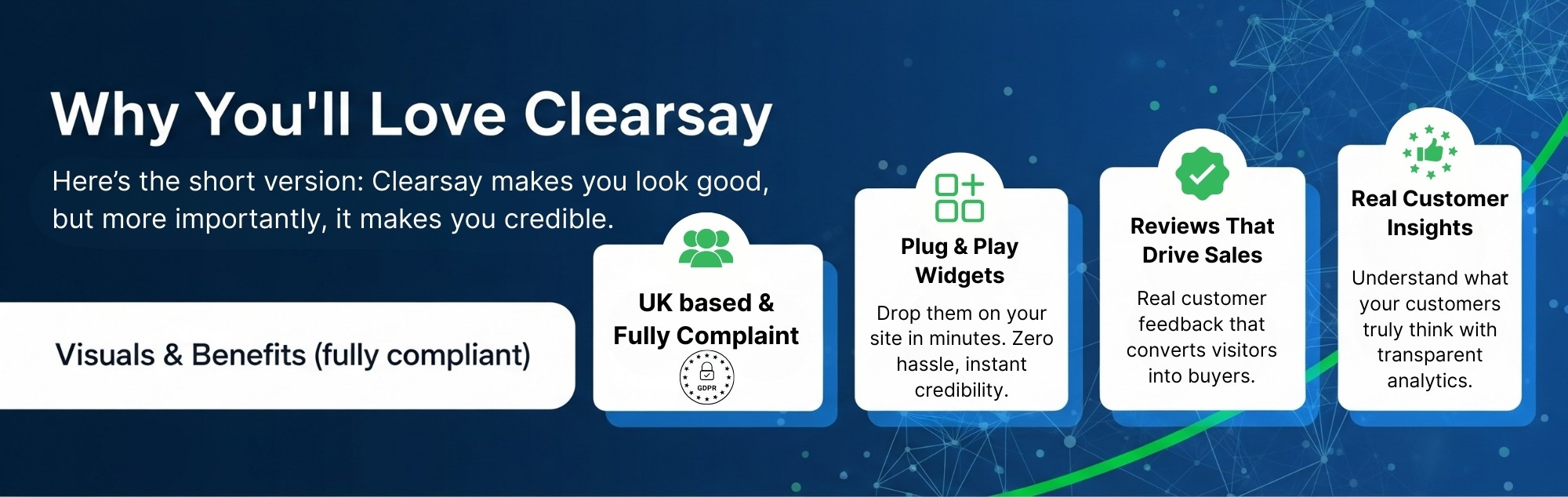
That is precisely where verified review models have strategic value. A review system works best when it protects both sides of the marketplace: the customer who wants to share an authentic experience and the business that deserves fair representation. Clearsay’s public guidance makes that principle explicit. Its user content guidelines state that reviewers must be over 18 to submit a review, and the platform’s published messaging repeatedly emphasizes authentic experiences, fairness, and trust. Clearsay also states that businesses can claim and manage profiles, collect and respond to customer reviews, and access analytics, including more advanced reporting on paid plans.
That combination is commercially important because trust does not grow from reviews alone. It grows from the quality of the review environment. Businesses do not just need more feedback; they need feedback that appears credible, relevant, and connected to real interactions. Customers, in turn, do not just want high ratings. They want signals that help them judge whether a company is dependable, responsive, and consistent.
A verified review ecosystem creates those signals more effectively than an open, loosely moderated one. When customers know a platform is taking authenticity seriously, the content carries more weight. When businesses know they have legitimate tools to respond, appeal, and improve, they are more likely to engage constructively rather than defensively. That changes the role of reputation management. Instead of being a reactive exercise in damage control, it becomes an operational discipline tied to customer experience, marketing performance, and long-term growth.

This matters even more as online reputation becomes intertwined with discoverability. Reviews do not sit in isolation. They influence how a business is perceived across search, social, direct visits, and referral traffic. A potential customer may first encounter your ad, then visit your site, then search your business name, then check independent reviews before deciding whether to contact you. That journey is no longer unusual. It is increasingly standard.
In that context, the value of a platform like Clearsay is not limited to public feedback. It also lies in how that feedback can be structured into something useful. Clearsay’s business offering includes profile management, review responses, widgets, review request tools, and analytics features, depending on plan level. Its business pages also emphasize visibility, engagement, and reputation management. These are not small add-ons. They reflect a broader market shift: businesses are beginning to treat trust infrastructure the same way they treat CRM systems, reporting dashboards, and paid media accounts. It is no longer enough to “have reviews somewhere.” The stronger model is to build a managed reputation layer that supports the rest of the business.
For smaller businesses, this can be particularly powerful. Many independent brands do excellent work but struggle to compete with larger players that dominate ad budgets and search exposure. Verified reviews can help narrow that gap. A strong profile built around genuine customer experiences gives smaller firms a more credible voice. It allows them to demonstrate service quality publicly, show how they respond to customers, and build a visible track record over time. In some categories, that matters more than scale.
For larger businesses, the opportunity is slightly different. Reputation management at scale requires structure. It requires governance, consistency, and visibility across customer sentiment. A platform that combines public reviews with business controls and analytics supports that need far better than an unmanaged review footprint scattered across the internet.

There is also an important cultural dimension here. The best review platforms do not simply display opinion; they create a healthier environment for accountability. Clearsay’s public materials place strong emphasis on community standards, transparent moderation, and authentic experiences. Its community guidelines describe a platform built around credibility, clarity, and mutual respect, while its trust-focused pages highlight tools for businesses to monitor feedback and improve services. That framing matters because review platforms increasingly shape how businesses and customers relate to one another in public. If the environment is hostile or chaotic, everyone loses. If it is structured and fair, the platform becomes more valuable for all participants.
For businesses, the practical lesson is not complicated, but it is important. Reviews should not be treated as a side issue delegated only to customer support or only revisited when something goes wrong. They should be part of the broader growth strategy. A review profile is often one of the first external trust signals a prospect sees. It influences confidence before a call is booked, before a quote is requested, and before a purchase is completed. In many cases, it helps decide whether the customer even enters the funnel at all.
That means the most effective businesses are likely to do three things consistently. First, they will make it easier for real customers to leave honest feedback. Second, they will respond to reviews in a way that demonstrates professionalism rather than defensiveness. Third, they will use the resulting data to identify recurring strengths and weaknesses. Clearsay’s own business positioning reflects this model by combining review collection, response tools, widgets, and analytics under one ecosystem.

There is another reason this matters now. Consumers are becoming more selective, not less. In uncertain economic conditions, people want fewer surprises. They want confidence before they commit time or money. As a result, review credibility becomes even more important. Businesses that can show a transparent stream of real experiences gain an advantage because they reduce perceived risk. Businesses that cannot do that are more likely to face hesitation, comparison shopping, and delayed decisions.
This is where Clearsay’s category structure and business discovery model also play a role. The platform publicly lists a broad set of business categories, from healthcare and finance to retail, hospitality, technology, and professional services. That breadth suggests a wider ambition than simply hosting reviews. It points toward becoming a discoverability and trust layer across multiple sectors. For a platform brand, that is strategically sound. For businesses, it means the value of participation is not only reputational but also contextual. You are not just gathering reviews in isolation; you are building presence within a category where customers are actively comparing options.
Ultimately, the shift underway is larger than reviews themselves. It is about the standard consumers now expect from the businesses they choose. They want transparency. They want fairness. They want evidence that a business is real, responsive, and accountable. Verified reviews meet that expectation far better than open systems built mainly for volume.
That is why the businesses that will stand out over the next few years are unlikely to be the ones shouting the loudest. They will be the ones building the most credible trust signals. In that environment, platforms like Clearsay are not just helpful marketing tools. They are part of the architecture of modern reputation.